by David Fuentes, Ph.D.
If you sing the opening of “What a Wonderful World,” you’ve also sung the opening of “Twinkle, Twinkle Little Star.” Same notes. Same order. And yet each song uses those notes to entirely different ends. In one, we hear the dainty petulance of an 18th-century French boy bargaining for bonbons; in the other, we hear the tender gravelly optimism of a venerable jazz superstar. And then there’s the music. Different rhythms, different pacing, different expressive weight. Normally, we’d chalk up this sort of melodic doppelgänger as a happy accident and move on.
But what if the resemblance is no coincidence?
What if these recurring patterns point to something composers have been relying upon all along without noticing—a shared vocabulary of melodic “figures”—common melodic shapes that quietly underpin every tonal melody we know?
Once we know which patterns to listen for, they’re nigh impossible to ignore. These compact, three- and four-note figures recur across styles, eras, and genres—not as surface similarities, but as familiar “agents”: bits of melodic motion that carry their own sense of direction and energy. What’s more, the deeper we listen, the more we find that these figures don’t just recur; they behave!
Melodic Figuration Theory (MFT) brings this intuitive vocabulary into the open. It identifies a few dozen recurring shapes and shows how each one harbors kinetic potential—implied ways of moving that influence how it normally urges a line forward or lets the composer modify it to create some special effect.
Because MFT also accounts for the natural, unformalized syntax that shapes how these figures interact, it can reveal something we rarely teach: that melody has its own interior logic—its own reasons for moving the ways it does, not solely dependent on the harmonic framework beneath it.
Most of us learned melody at two levels. At the macro level, we study form, phrase structure, and the harmonic frame beneath a melody. At the micro level, we study intervals, chord tones, and voice leading. But between these two well-mapped layers lies a third: the mezzo level—the layer of melodic figures and gestures, where melodies do their most expressive, agile work. And although it’s been the composer’s playground for eons, nobody handed composers a map. Theorists have surveyed parts of it for their own purposes. MFT draws the map a composer would want: what’s there, how it moves, and what you can do with it.
Here’s the lay of the land.
Tier 1: The Vocabulary of Melody consists of 36 distinct elements, anchored by 24 melodic figures—the pre-melodic gestalts underlying tonal melody. Their essential character persists, no matter the rhythmic, harmonic, or registral setting. Each figure has kinetic potential and characteristic tendencies—tendencies the composer can yield to or subtly redirect.
Tier 2: The Five Dimensions of Figural Behavior. MFT focuses on what’s directly perceptible: five moment-by-moment dimensions composers can learn to recognize and control. Central to MFT is the insight that every dimension operates in two modes: straightforward behavior, which follows expectation and creates flow, and modified behavior, which arrests attention and generates expression.
Tier 3: Melodic Syntax explores the responsive nature of melodic logic. The composer transforms a melodic figure into a melodic gesture by adding rhythm. In this way, the figure is not the smallest intact unit of melody; the melodic gesture is. Whereas melodic figures possess kinetic potential, melodic gestures are fully kinetic. In music as in life, a gesture harnesses conviction and emotion to convey meaning with immediacy. Going further, just as a conversation hinges on the felt relationships between a statement and a reply, MFT brings to light ways that gestures interact through a finite system of responses to build cohesive, dynamic phrases.
Tier 4: Melodic Schemas shows how MFT opens ways to build comprehensive frameworks grounded in the emergent logic of tiers 1–3. This is where patterns of behavior and expectation solidify into something a listener can apprehend as a whole—regardless of style, length, or complexity.
TIER #1: THE VOCABULARY OF MELODY
Imagine, for a moment, that there’s no such thing as chords. Any time a composer wants a harmonic bed for their melody, they have to invent every sonority from scratch. Note by note, through trial and error, finding combinations that feel pleasant, harsh, settled, restless—they eventually discover the perfect blend for their melody’s first three notes. Then, after a quick trip to the kitchen for a fresh cup of coffee, it’s time to start hunting for the next one.
Of course, this isn’t how composing works. The system we now call harmony developed over centuries: voice-leading in medieval and Renaissance polyphony, figured bass in the Baroque, and finally Rameau’s functional logic, which we still use today. The result was a stable inventory of chords—triads built by stacking thirds, sevenths added for tension or color—each with predictable behaviors composers could draw from, adapt, and combine.
No composer needs to reinvent the major triad 43 times a day. No one has to rediscover that a dominant seventh pulls toward resolution. Knowing your chords frees you up for the decisions that actually shape a piece: how long to hold each one, where to change, what to change to, what to save for the big surprise.
So tell me: Why do composers have to make up every melodic pattern from scratch? Or do we? As it happens, every composer draws from the same small, recurring set of melodic shapes. We just don’t have names for them; and we’ve never sorted them by type, behavior, or quirks. We use them the way native speakers use idioms—fluently, instinctively, without realizing we’re reaching for a shared vocabulary.
Here’s that vocabulary. The table is interactive. Click on any figure to hear how it behaves in a few well-known melodies across eras and genres.
You've heard every one of these figures at least ten thousand times. So why does seeing them laid out like this feel like a first encounter? Bare, out of context, it’s hard to even call them music. But all that changes the moment we hear them in action.
This vocabulary has always existed. Pieces of it have been written down before. MFT writes it down whole—and asks how each figure behaves.
Composers don't learn these shapes through formal study. We pick them up the way we picked up our first language—by ear, by repetition, by being surrounded by music. Melodic figures became a shared vernacular not by scholarly decree, but through the collective muscle memory of generations of composers.
Mark this well. Melodic figures aren't merely patterns that recur from piece to piece. Each one carries intrinsic kinetic potential—a built-in way of moving you can recognize in any setting. This is what separates MFT from pattern-matching. A melodic pattern recurs; a melodic figure behaves.
That kinetic potential manifests in two ways:
- Isolated motion (motion within the figure): Each figure's shape dictates a specific internal shifting of weight from first note to last—much like the curves and chutes of a waterslide choreograph the rider's experience.

- Integrated motion (motion beyond the figure): The momentum a figure builds doesn't stop at its last note—it follows through, connecting to the next figure or terminus with its own logic and consequences.

Isolated and integrated motion are properties of the figure itself. Still, they're tendencies—the most likely behavior in most contexts. This is what MFT calls straightforward behavior—the figure doing what its kinetic potential inclines it to do. However, tier 2 will show how composers can override a melodic figure's natural tendencies to generate expression—what MFT calls modified behavior. Without a straightforward, there'd be nothing to modify.
This is also why MFT stops short of claiming melodic motion is fully autonomous. The figures supply the raw kinetic material. The composer's ear still judges what to do with it. Unless she builds her line from well-chosen, sensibly placed figures it will arrive dead on the page (and offensive to the ear). Kinetic potential is the engine, but not a guarantee.
Welcome to the mezzo level.
Melody is an act of physical exertion. When we hear a melodic line, we don't just register a sequence of pitches; we sense weight, friction, momentum, and elasticity. We feel gestures pushing against gravity, stretching across spatial gaps, and leaning into the future.
Kinetic character belongs to the figure, not to any single realization of it. The same figure can actualize different ways in different contexts. Think of how a Double Neighbor can behave as one prolonged tone or as an ornamented path toward the next figure's opening note; and both count as straightforward motion. It's this shared kinetic ground that makes comparing such different realizations possible at all.
Double Neighbor figures ascending by step and descending by 3rd
Melodic figures open the way to draw meaningful melodic comparisons between one situation and another.
The ability to identify a limited, shared vocabulary of melodic elements opens up something I never had as a student: the ability to compare one melodic situation with another on the same terms regardless of style or era. Why does this matter? Because comparison is how every field moves forward. Practical insight doesn't arise from isolated facts. It comes from lining things up and asking, "What makes one figure's resolution feel inevitable while another catches us totally off guard?"
Material scientists develop stronger composites by comparing how structures respond under stress. Astrophysicists chart the universe by comparing light from distant galaxies to evolving cosmological models. In each case, the breakthrough came not from gathering more data, but from naming the right units.
Now that we can identify the vocabulary of melody, we can look as close as we want. By comparing how the same figure behaves in different situations, we can map straightforward and modified behaviors across five key dimensions of figural behavior—localized harmony, metric placement, connection, register, and shape—as dependably as we can demarcate the regular and irregular resolutions of a dominant seventh chord. And here's what the comparisons reveal: composers across styles and centuries haven't just played straightforward against modified to charm, stir, move, and unsettle us—they've done it in the same ways to achieve the same effects, as the next tier will document. That's what makes MFT instructive, not just descriptive. Every technique it names comes attached to composers who already use it well.
TIER #2: THE FIVE DIMENSIONS OF FIGURAL BEHAVIOR
[1] Harmonic Melody
An experienced stonemason doesn't need to measure every rock to know if an arch will hold. They scan the pile, weighing a stone or two in their hands, sensing for curve and ambit—a gestalt impression that transcends calculation. Apprentices see a pile of stones; the mason envisions the arch.
The way most of us were taught harmony lacks this gestalt. We learned to sort a melody's notes one at a time: chord tones vs. "embellishing" tones. The label betrays the problem, signaling that some notes are merely second-class citizens. In reality, what we call passing tones or neighbor notes aren't like gargoyles on a cornice—extraneous and decorative. Every note is a stone in the arch—pull one out and the figure collapses. Each one shapes both the figure's contour and its harmonic footprint. For instance, if we raise or flatten the passing note D in the 3-note scale C-D-E, we get a drastically different harmonic impression.
Like the experienced stonemason, an experienced musician doesn't need to measure every note. She recognizes whole patterns—figures—and the harmonic framework they carry. The shape alone reveals the bones.
Try for yourself. Scan these five figures and let your ears anticipate their harmonic content. You'll find the contour alone is enough to signal the underlying structure. Then play the video to reveal their "skeletones."
A. The straightforward harmonic behavior of melodic figures places the first skeletone on a beat.
One of the most reliable conventions in tonal music is that harmony changes on the beat. And skeletones follow suit.
"Away in a Manger," by James R. Murray
Comparing harmonic behaviors will be clearest when only one thing changes at a time. So the rest of Tier 2 uses a single figure in every example—the 3-Note Scale. Same figure, four harmonic applications: straightforward behavior, straightforward behavior with reinterpretation, role reversal, and harmonic divergence.
Reinterpretation. Any skeletone within a melodic figure can be reinterpreted, as shown in the following chart. As you study it, start with the first column. In the top row, the skeletone C4 is the root in C major. Drop to the second row, and C4 is the third in A minor. And so on.
Harmonic flexibility based on the number of chord tones.
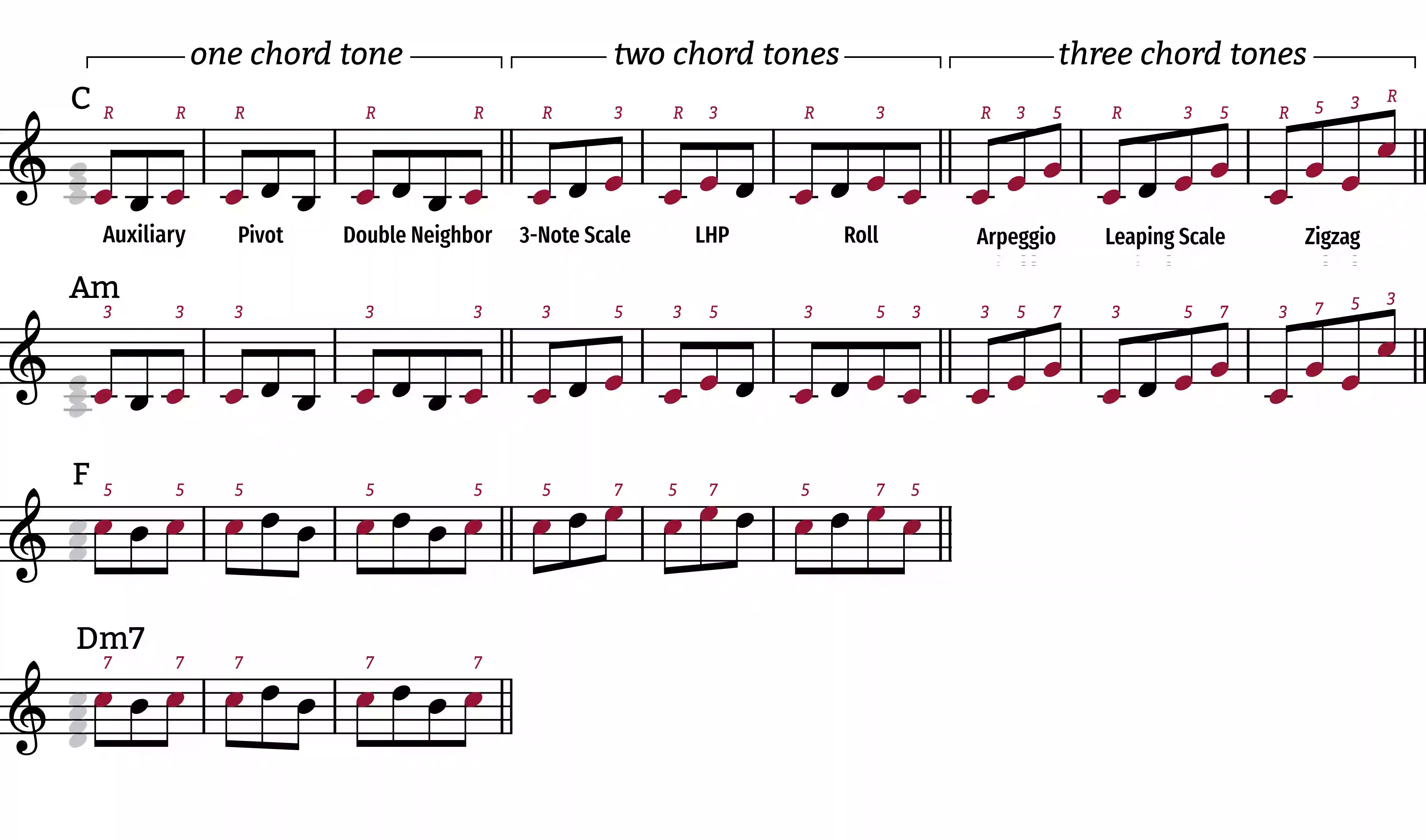
Notice that throughout every reinterpretation, the skeletones never abandon their structural role—they remain the harmonic backbone of the figure. Only their harmonic identity changes. This is why reinterpretation is straightforward behavior: the figure's internal architecture stays intact.
Now I'll reharmonize "Away in a Manger." Originally, the first figure's skeletones were the 5th and 3rd of F harmony. This time I'll make them the 7th and 5th of D7. Bar 2 gets a similar reinterpretation. (I'll explain what happens to the skeletones in bar 3 in the next point.)
"Away in a Manger," reharmonized
B. Modified harmonic behavior of melodic figures #1: role reversal.
As we just heard, reinterpretation is an extension of straightforward behavior: a figure's skeletones keep their structural role—they remain skeletones—even as their harmonic identity changes.
Role reversal goes further. Reinterpretation changes a skeletone's harmonic identity while preserving its structural role. Role reversal changes the structural role itself—what was a skeletone becomes a non-chord tone, most often an appoggiatura.
Here's what that sounds like in practice. Listen again to the third 3-Note Scale (on "crib for a") in the previous reharmonization. Normally, F4 and D4 (notes 1 and 3 of the figure) would act as skeletones making the middle note a passing tone. But not here. F4 becomes an appoggiatura to E4 (the only chord tone in the figure), simultaneously changing D4's role to passing.
Changing a skeletone to an appoggiatura is more drastic than simply reinterpreting it as a different skeletone. Still, each member of a harmonically reinterpreted figure has a clear harmonic role. That's not the case for the next form of modified behavior.
C. Modified harmonic behavior of melodic figures #3: harmonic divergence.
Like "Away in a Manger," "Eleanor Rigby" also uses three 3-Note Scales in sequence—but this time, by resisting and even ignoring the underlying harmony. Let's zoom in on the first two figures.
The D5 (on "rice") punches out a 7th—especially zesty because it's not heard in the supporting E minor chord. What's more, it also contains a chromatically altered passing tone—C#5 (on "in")—which adds a Dorian hue. And then comes the 3-Note Scale (on "church").
The figure plants its flag squarely against the harmony—and wins. Its kinetic integrity is simply stronger than the pull of the underlying chord. Nothing sounds wrong—if anything, the dissonance sharpens the emotional point, adding urgency and depth exactly where the lyric demands it.
"Eleanor Rigby," by Lennon & McCartney
So the harmonic divergence "Eleanor Rigby" arises from transposing a 3-Note Scale while holding a single harmony. But in "Breathe," the melodic figure itself remains steadfast while the harmonies around it change.
"Breathe," by Holly Lamar and Stephanie Bentley
Some may argue that the two highlighted B4s are appoggiaturas, implying that there's nothing unusual about the harmony of these 3-Note Scales. I'll counter that we hear all three 3-Note Scales the same way: as a sort of several note pickup to G4. In MFT, we call this sort of pickup a "ligature," which I explain in the next section, "Metric Placement."
Harmonic divergence exposes an essential truth in Melodic Figuration Theory. While melodic figures certainly have the potential to clearly define harmony, composers and improvisors also freely use them purely for their shape. In other words, the elemental patterns of melody have such kinetic integrity that they often sound "right" even when they don't clearly delineate a clear, stable harmony.
Wrapping up. Melodic Figuration Theory flips the traditional script regarding the relationship between harmony and melody. Rather than taking a note-by-note inventory to separate chord tones from non-chord tones, MFT advocates that skeletones form a harmonic framework for each melodic figure, which offers a more comprehensive understanding of how the notes in a melody interact in harmonically cogent ways. And so we find that harmony isn't just a backdrop for melody—it's structural material, built directly into the shape of every figure. Harmonic divergence doesn't contradict this; it confirms it—proof that a figure's kinetic integrity can be strong enough to stand on its own.
[2] Metric Placement
Meter is music's essential pulse: a living, dynamic cycle of strong and weak beats that acts as a gravitational engine. Depending on how musical elements align with that engine, a composer can generate feelings ranging from deep stability to playful confidence to intense agitation. That range is possible because meter works on us physically before it works on us intellectually.
When listening to or playing music, we internalize the metric cycle as a continuous flow of physical sensation—the gravitational weight of a strong beat landing, transferring its energy upward through the weaker beats that follow, each one lifting toward the next point of contact. Think of a sprinter's foot pushing off the ground. Musical elements—including each note within a melodic figure—take on the characteristic lift and heft of the metric positions they inhabit.
To hear this principle in action, listen how drastically the same 2-note surface rhythm changes as I shift it to begin at different points within the metric cycle.
A 2-note rhythmic pattern repeated four times while repositioned in the metric cycle
- In version 1, the sixteenth note is a pickup, coming just before the beat which makes the rhythm bounce and skip.
- In version 2, putting the sixteenth note right on the beat syncopates the dotted eighth such that both notes feel "hammered" or "beaten."
- And version 3 avoids the beat altogether, making the notes run barefoot across hot coals.
Of the three metric placements, version 1 emerges as the straightforward alignment for this rhythmic figure because its heaviest (longest) note aligns with the beat. This distribution of short and long notes affirms the most stable relationship between the rhythmic figure's weight and the meter's cycle.
A. Metric placement influences both melody and harmony.
Shifting a pitch pattern to different positions within the metric cycle does something unexpected: it doesn't just change where the pattern sits. It changes what the pattern is—something that catches even experienced musicians off guard.
A 17-note melody made from a 4-note repeating pattern, shifted metrically each time
Shifting this 17-note series within the metric cycle causes different melodic figures to emerge. The notes haven't changed. Where the beat falls decides which figures we hear. We can also say that the same series of notes can produce different melodies when we start it at different points within the metric cycle. The shifts also create different implied harmonies each time. This is mind-bending but perfectly logical, especially when we consider that harmonic rhythm is tied to meter, a well-established fact we all learned in second semester theory class.
In the previous section (Harmonic Melody) we saw and heard that melodic figures have a harmonic dimension. Now it appears that they have an metric dimension, as well. And that metric dimension manifests in two ways: (1) straightforward and modified ways to align figures within the metric cycle, and (2) interior rhythmic/metric motion within melodic figures.
B. Straightforward and modified metric placement of melodic figures.
- The straightforward metric placement for any melodic figure is this: start on a beat, which (depending on the number of notes and the rhythmic value) leaves its last note "dangling" on an upbeat. This positioning creates a sense of grounding at the beginning and open-endedness at the end.
- We can modify the straightforward behavior of a figure by repositioning it differently within the meter.
In the example below, versions B–D show modified metric alignments of the 3-Note Scale.
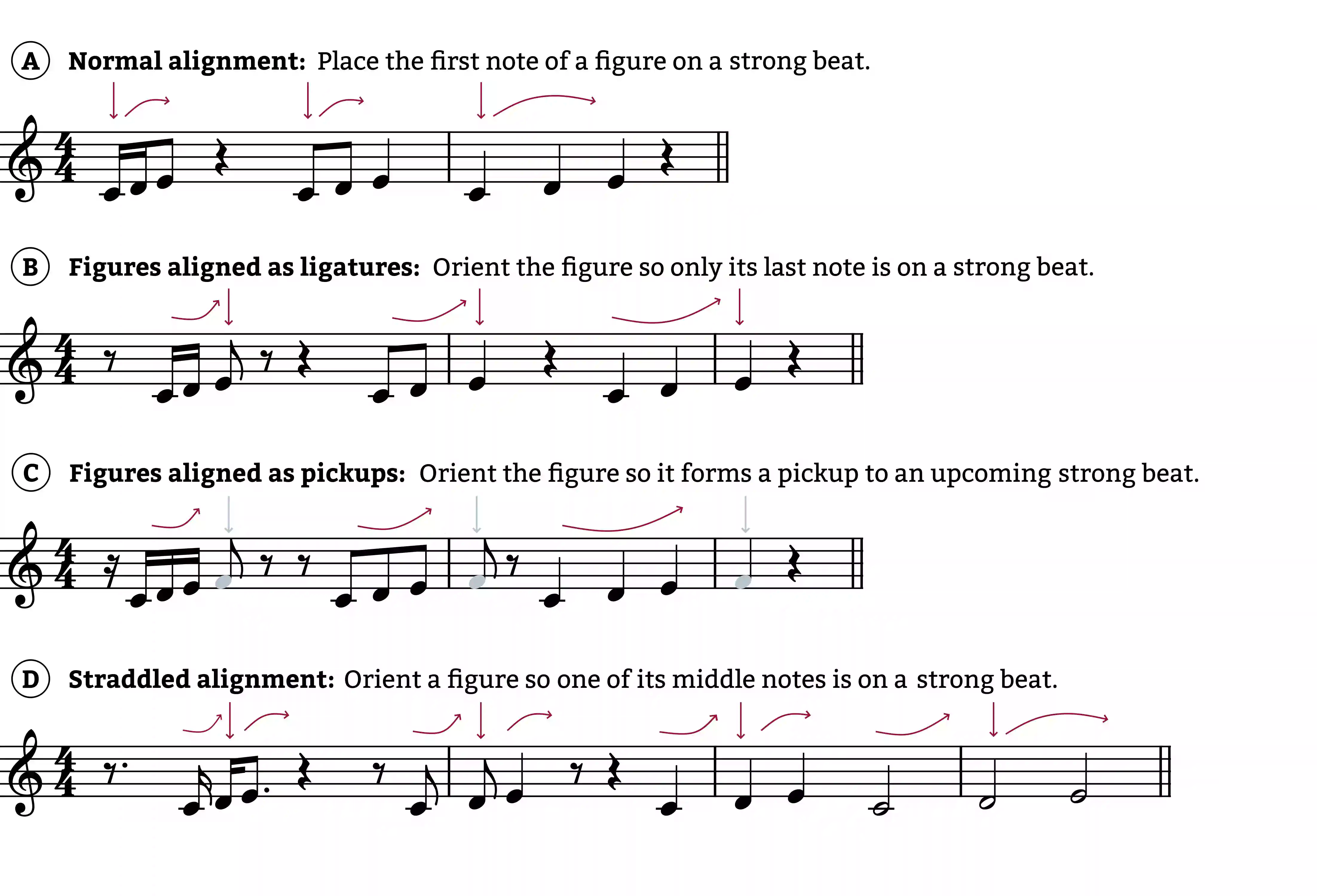
For examples from actual songs, I'll start with the same 3-Note Scale melodies from the section on harmony, this time marked to show their metric placement.
- "Away in a Manger" uses straightforward alignment.
- "Eleanor Rigby" uses straightforward alignment with syncopation. Syncopation only slightly modifies metric placement. That's because in syncopation, the first note of each figure "jumps the gun" to get to the upcoming note a tad early. The result is a lengthened note that still occupies the same metric spot.
- "Breathe" presents with an entirely different metric placement. Its 3-Note Scales are ligatures, set up so that only the last note lands on the strong beat. And the repeated notes in those 3-Note Scales create anticipations to each upcoming pitch.
In all three songs, I've used bold formatting to show how the accentuation of important syllables corresponds to the strong beats, making the lyrics easy to grasp. Those familiar with the concept of prosody will recognize that the music in our speech relies on the same metric principles I've shown in this section.
Next, we hear the 3-Note Scale as a pickup. Though this figure is a common choice for a pickup of this length, notice something a bit odd: the scale doesn't land where it leads. That is, the stepwise motion doesn't follow through across the beat, but rather leaps. And because the note it leaps to is an appoggiatura, this particular pickup configuration packs quite a wallop. I have more to say about leaping away from stepwise motion in the upcoming section on "Connection."
"The Greatest Show on Earth," by Victor Young
Finally, the straddled figure that opens "Desperado" encapsulates its central theme: asking a road-weary outlaw why he never seems ready to settle down. This gets intensified through harmonic divergence. The B4 that initiates the gesture belongs to the upcoming G chord, not the current D major. Still, the ear immediately grasps the implications of the unsettled harmony.
As for rhythm and meter, the last two syllables, "ra-do," are both syncopated, but not in the same way. The first arrives early, the second comes late, such that the melody itself resists any notion of putting down roots. Taken together, these precise pitches and rhythms create a potent, yet understated, confluence that captures the song's emotional weariness and longing in a single, telling gesture.
"Desperado," by Don Henley and Glen Frey
C. Interior rhythmic/metric motion within melodic figures.
The interior motion of many melodic figures can make them seem to go with or against the natural "grain" of the meter. Here are three examples. In each case, I've rewritten the same figure differently to produce different rhythmic groupings, each with metric implications. I indicate the implied rhythmic groupings they create with slurs and also re-notated them in the ossia line.
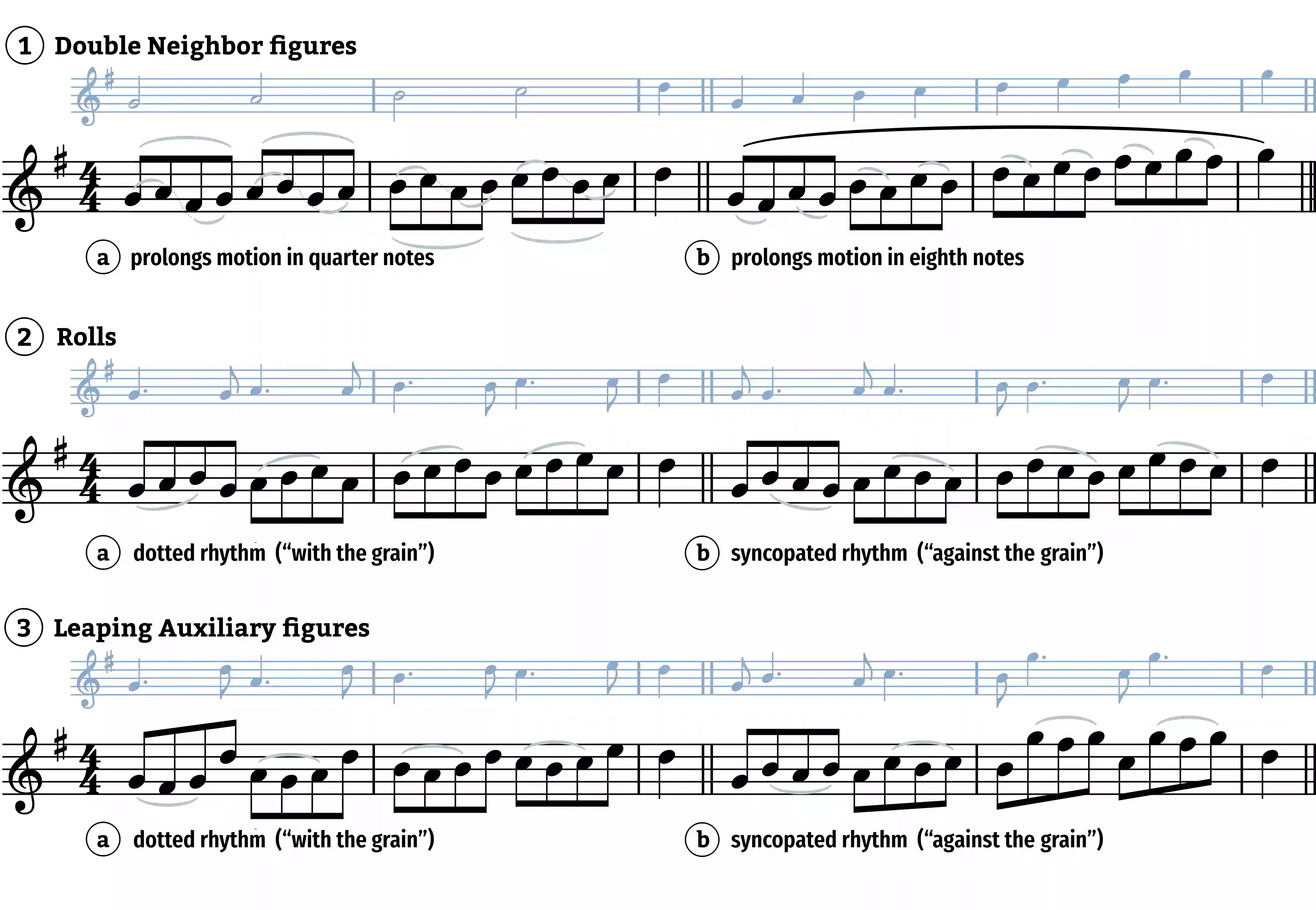
Wrapping up. Melody draws kinetic energy and expressive power from its placement within the metric cycle—not just by landing on beats, but by negotiating with them: arriving early, settling late, hovering between touchpoints, or pushing off from them with deliberate force. The same melodic figure can whisper or shout, float or pummel, depending entirely on where it sits within that cycle. This is why a composer's figure choices, as important as they are, tell only half the story. Where you place them matters at least as much—perhaps even more. Master metric placement, and you don't just control rhythm. You control how every note in a melody is physically experienced by your listener.
[3] Connection
The word connection already has several applications in melody. On the note-to-note level, we imagine each note connecting to the next note, but because the notes actually sound off one at a time, this is an "audio illusion." Moving to the phrase level, listeners often sense a melodic chain or ribbon of notes extending all the way from first to last. And then there's a totally different sort of melodic connection involves short- and long-term memory that help us compare what we just heard with what happens next and probably much later, as well.
However, the two types of connections we'll explore here are ones I've never seen named or taught—which is odd, given how much of a melody's flow, expectation, and expression hinge upon them. Composers across styles and centuries have wielded these connections with remarkable sophistication. They do it by ear.
A. The beat as a melodic target.
In the previous section on metric placement, I used the analogy of a sprinter's foot pushing off the ground to capture the most intense moment within the metric cycle. Both connections we'll cover in this section depend on understanding the melodic implications for this moment.
While the running analogy provides a good starting analogy, we must now account for a glaring difference. The sprinter doesn't have to think about where each foot will land, trusting that the track maintenance crew has sufficiently provided a level surface to run on. But in a melody, some "footfalls" will be higher or lower than others—sometimes drastically so—such that a melody must "aim" for each beat, and decide which pathway to take.
7 Ways to get from D to G using eighth notes
The first option takes the most direct path, which we also mark as the straightforward connection. It's simple, efficient, and feels absolutely familiar. Of course in music, "straightforward" hardly implies "best." In certain contexts, the direct approach feels confident and elegant. In others, the same pathway can come off as blunt, cliché, emotionally flat.
These choices lie at the heart of melodic connection. Melody moves in time. Its touchpoints are bound to measured time. And so, each melodic figure choice commits itself to a pathway that either falls in line with, defers, or even resists the bounds of musical time. Particularly when lyrics come into play, such choices can shape their meaning, as you can hear in the two melodies below.
Both span D5 to G4, the very same fifth as the examples above. Each excerpt has also been decomposed using the "opposite" pathway: if the original takes a direct route, the ossia takes a diverted one, and vice versa. The differences aren't merely mechanical. Listen to how the expressive physicality of a line shapes its meaning.
"The Halleluia Chorus," from The Messiah by George Frideric Handel
"A Groovy Kind of Love," by Toni Wine & Carole Bayer Sager (The Mindbenders)
The angular shape of Handel's melody makes it nearly impossible to sing legato, driving home its weighty theological message. The opposite holds true for "A Groovy Kind of Love." Notice how the same pathway that works perfectly in one situation can spoil another.
B. Melodic links.
A melodic link hones in on just a small portion of a melodic pathway, which happens to be at the most critical moment in the metric cycle: the transition between beats. And so, a melodic link involves exactly three notes: the last two of the first element and the first note of the second. That means that melodic links can occur between:
- two melodic figures
- a melodic figure and a melodic dyad (in either order)
- a melodic figure and a single tone (in either order)
- or a single tone and a dyad (in either order).
Further, melodic figure links can involve any type of melodic motion: steps, leaps, and repeated notes.

C. Straightforward (seamless) vs. modified (accented) links.
When making links, not all types of melodic motion are equivalent. Stepwise motion at the end of a beat cycle creates an urgent expectation to continue moving stepwise to the upcoming beat, while neither leap-wise motion nor repeated notes exhibit any particular inclination. And so, this section focuses on links where the first figure ends with stepwise motion.
Letting stepwise motion at the end of a beat continue by step into the next beat creates a seamless (straightforward) link. By contrast, leaping from stepwise motion at the end of a beat creates an accented (modified) link. The effects are easy to hear. Seamless (straightforward) links feel smooth, natural, even inevitable. Accented links, by contrast, create a "written in" expressive accent—one that's nearly impossible to perform legato.
Seamless and accented links following a 3-Note Scale
These next two songs use the formula for accented links to celebrate the experience of "making it."
"Looks Like We Made It," by Richard Kerr and Will Jennings
"Theme from New York, New York," by John Kander and Fred Ebb
There are a very few exceptions to this guideline. For example, the step-leap link formula in pentatonic melodies won't produce an accent as long as the leap (gap) is a minor 3rd. Similarly, sometimes a modified metric placement seems to create a step-leap link crossing a beat. Such is the case in the next example with the Double 3rd as a ligature.
"If I Only Had a Brain," by Harburg and Arlen
What we've gotten wrong about leaps
The phenomenon of seamless links raises questions about stepwise motion throughout the metric cycle (i.e., stepwise motion before the end of a beat). And here, we come to a pervasive miscalculation within the pedagogy of melody. Our failure to notice that some but not all stepwise motion creates an expectation to continue by step has resulted in the highly misleading requirements teachers give beginning students: "Move mostly by step, adding just a few leaps for variety." (This reduces the balance of steps and leaps to a ratio.) Actual composers "break" this rule so often it can hardly be considered a rule, not even for novices.
Follow through before starting anew.
In most industries, progress isn't just sequential, it's also conditional. Workers and engineers alike must secure a formal sign-off on the current phase before moving on to the next. Melody is no different. Each phase of a phrase must "sign off"—complete its gesture—before starting the next one. As you'll soon see, obeying this "rule" opens the door to more freedom than restriction.
Listen to the two large leaps in Bach's "Invention #11." They're not only large, they're dissonant (minor 7ths).
"Invention #11," by J.S. Bach
But are they really leaps of a minor 7th? Another way to hear this melody is that each large leap initiates a new phase of the phrase. I've marked the first leap to illustrate this below.

Metric placement plays an essential role in making this melody comprehensible. In the next example, I've shifted both of Bach's leaps to break the natural flow of the metric cycle: leaping between beats rather than letting stepwise motion take its natural course. Even though the interval size remains unchanged (the new leaps are also minor 7ths), leaping a 7th between beats sounds harsh whereas leaping a 7th after a beat doesn't. To fully appreciate the differences, I urge you to sing along with the video. The cross-beat leaps not only sound wrong, they're much harder to sing.
Moral of the story? When it comes to leaping, timing matters more than distance.
While we're on the subject of linking melodic figures, let's consider two more applications: (1) phrase parsing and (2) funk.
First, notice Bach's accented leap to D5 and the musical reason for it: The accent heralds an impending cadence. This shows that Bach was aware (even if intuitively) of the difference between smooth and accented links, plus when and why to use each.

Going further, we find occasions where Bach set up far-reaching passages that alternate smooth and accented links to achieve syncopation. Take "Prelude #5," for example.
In bar 1, all four beats receive emphasis via accented links. Then things get funky in bars 2-8 where a syncopated pattern ensues. This same 8-bar pattern—accented links on all four beats in bar 1, syncopation for the next seven—repeats three times through bar 24. That's no accident. That's architecture. And this isn't a casual observation. Bach's alternation of seamless and accented links produces a rhythmic momentum that genuinely swings—another famous example being Invention #4. Performers feel this swing. I haven't seen it explained. With a formula for telling seamless links from accented ones, you can point to exactly where it comes from.
Here, I've marked the smooth links (on beats 1 and 3) with slurs and used red noteheads to highlight the accented links. Of course, in Bach's time, people didn't mark articulations this extensively (if at all). In this prelude, articulations would be superfluous: the performance instructions are indelibly woven into the melodic line. In fact, I invite you to listen to any recording (or play the piece yourself) and you'll feel the syncopation so clearly you'll swear there must also be a drum track.
"Prelude #5 in D," WTC I, by J.S. Bach
(Kinetic potential. Kinetic potential…)
Wrapping up. Through understanding how melodic figures connect with each other as they align within the meter, Melodic Figuration Theory offers the composer precise ways to control melodic flow and expression. We can decide to take straightforward or modified pathways between melodic targets—arriving with confidence, hesitating at the threshold, or vaulting past it entirely.
Narrowing the focus to the juncture between beats, we found ways to fine tune melodic connections further through a variety of link formulas, including formulas for seamless vs. accented connections. Finally, we found that completing a melodic gesture before launching the next isn't a restriction—it's what gives composers the freedom to leap as far and as boldly as they like, landing exactly where the music needs to go.
[4] Register
Each melody occupies a given registral "space" delimited by its lowest and highest notes. Very few melodies inhabit all of the available registral space all the time. Instead, most establish a "home" register only to venture away and back, treating register much like a tonal center. That's the big picture. However, it's often the more localized strategies that provide the greatest intrigue. For example, shifting registers can break a melody into a back-and-forth dialogue (compound melody). Also, manipulating register offers one of the most effective ways to contrast one gesture or phrase with another. And finally (for now), many composers use register to create "plot twists"—those sudden, striking notes that jolt or delight us, and hit us like a surprise reveal in a thriller, flipping our expectations.
Once again, Melodic Figuration Theory, with its ability to precisely define each figure's registral properties and behaviors, is well placed to explore and catalogue the full expressive power of this under-discussed dimension.
Melodic figures and registral span.
"Registral span" refers to the distance between the lowest and highest notes in a melodic figure, gesture, or phrase. And here, one of the quiet strengths of melodic figures comes into focus: each one carves out its registral span with clarity and precision.
Half of the 24 melodic figures are "fixed," meaning their registral span never changes—ranging from a 2nd to a 4th. As shown in the graphic below, these figures move mostly by step. Any leaps are limited to a 3rd, which we refer to in MFT as "gaps." (To highlight gaps, I've filled them in with faint noteheads.)
The fixed figures arranged by their registral span
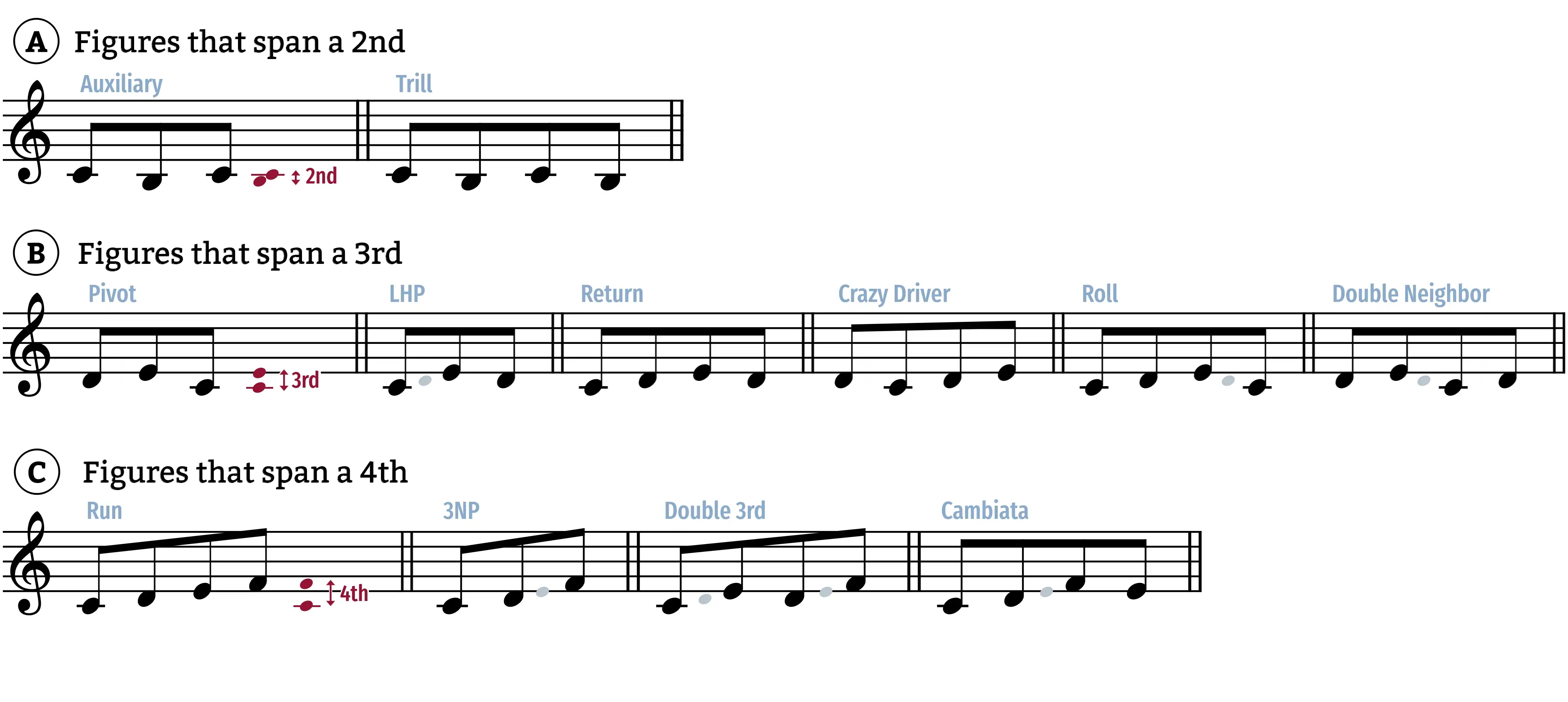
The remaining 12 figures are "flexible," and can span from 4th to however far a performer's instrument and proficiency allows. In each case, the flexible figure contains a true leap, which unlike gaps can expand or contract at will. Here are a few examples.
Some flexible figures

A. Controlling the slope.
Registral span is a vertical measurement. But when we hear register unfold over time (even a very short time), it's better understood as "slope"—the degree and speed that a melodic gesture rises or falls. Take the first two gestures in the chorus of "Best of My Love." Both involve nearly the same number of notes (4 notes vs. 3), but the first rises a 6th while the second falls a 3rd. The first slope is steeper than the second. Once you're aware of how slope can contrast, you'll be surprised at how often you encounter it.
"Best of My Love," by The Eagles
Balanced, but not formulaic. The ossia line in the previous example lets us hear what can happen when we directly mirror the slope between a pair of ascending and descending gestures (the most straightforward response). The dialogue feels too predictable.
Now let's zoom out to hear the registral plan of the entire phrase. The melody opens with a generous, upward-leaping arpeggio. Each gesture that follows drops just a little, until the melody settles back into its original register: a strategy (schema) known as a gap-fill pattern. You'll hear it in songs like "Over the Rainbow" and "Twinkle, Twinkle Little Star" plus countless melodies across all styles.
But in this phrase, we get a modified version of the fill. The third gesture ("you get the best of my") uses the Oscillator—a figure that hovers rather than descends. Lingering for a moment gives the phrase exactly the breathing room it needs. And there's another twist at the end: the super quick, final drop on "love." All told, the figures in this phrase don't just vary in pitch—they vary in slope, each one shaped and timed to fit its expressive moment. The special contribution of MFT in this context? Because MFT includes figures that share the same span but differ in slope, this kind of fine-grained shaping becomes more vivid and more controllable.
If straightforward applications of slope occur when the overall contour of a melodic figure matches the overall descent or ascent of a melody, composers can modify slope by using figures that go against the grain of the melody's overall direction. Such is the case in the next example where descending 3-Note Scales actually push the line upward.
"O, For the Wings of a Dove," by Felix Mendelssohn
Typically, a melody's registral movement feels organic—rising and falling in ways that seem natural and unforced. Isolation and overstepping the line both break that spell deliberately, using register as a tool for sharp contrast rather than gradual shaping.
B. Isolating registers.
Figures with fixed spans are also effective at partitioning an entire phrase into separate registral regions. "Oh Bess" begins with a gut-wrenching wail by putting its pickup far beneath the melodic space that follows, launching the melody from a place of raw, aching vulnerability. The response, set in a lower tessitura—one that feels more resigned—leaving no doubt about the answer: he already knows the heartbreaking answer to his plea.
"Oh Bess, Oh Where's My Bess," from Porgy and Bess, by George and Ira Gershwin
C. Overstepping the Line.
The lyrics in "Nobody Told Me" present a more fluid kind of inner dialogue than "Oh Bess," and the registral scheme follows suit. Each four-bar phrase builds upward through mostly chromatic Runs, unfolding two bars at a time. While the line feels continuous, it still carves out two registral zones. This time, the division isn't created by registral distance but by a mid-phrase pause that momentarily clears the slate.
In bars 5–8, Rodgers repeats the first phrase nearly verbatim. But then comes the plot twist: at the word "quake" where the melody leaps a minor 3rd. In a chromatic context, any leap can feel enormous. More importantly here, "quake" breaks through the melody's earlier "ceiling," established when the first phrase peaked at B4. And so, with the arrival of C5, that ceiling gives way—making the new high note feel even higher than it is.
Overstepping the line is a classic melodic technique: (1) establish a (temporary) "boundary," (2) retreat, then (3) exceed it. The result is a surge of expressive energy, achieved with little more than a well-placed leap.
"Nobody Told Me," by Richard Rogers
Wrapping up. Composers—from Baroque to jazz to pop—have long relied on register as a core expressive tool, using similar tactics to anchor, bend, or shatter registral boundaries. Melodic Figuration Theory uncovers register's structural and expressive power, revealing how fixed figures hold their ground and flexible figures expand or contract as needed. Such distinctions allow composers to take a strategic approach to register: Perfectly shaping and timing registral slope, establishing different isolated zones, or marking a clear registral boundary—only to vault past it for maximum drama.
[5] Shape
To prevent aimless wandering—a common novice melodic flaw—many instructors provide basic melodic templates to act as guardrails.
Six common melodic shape templates
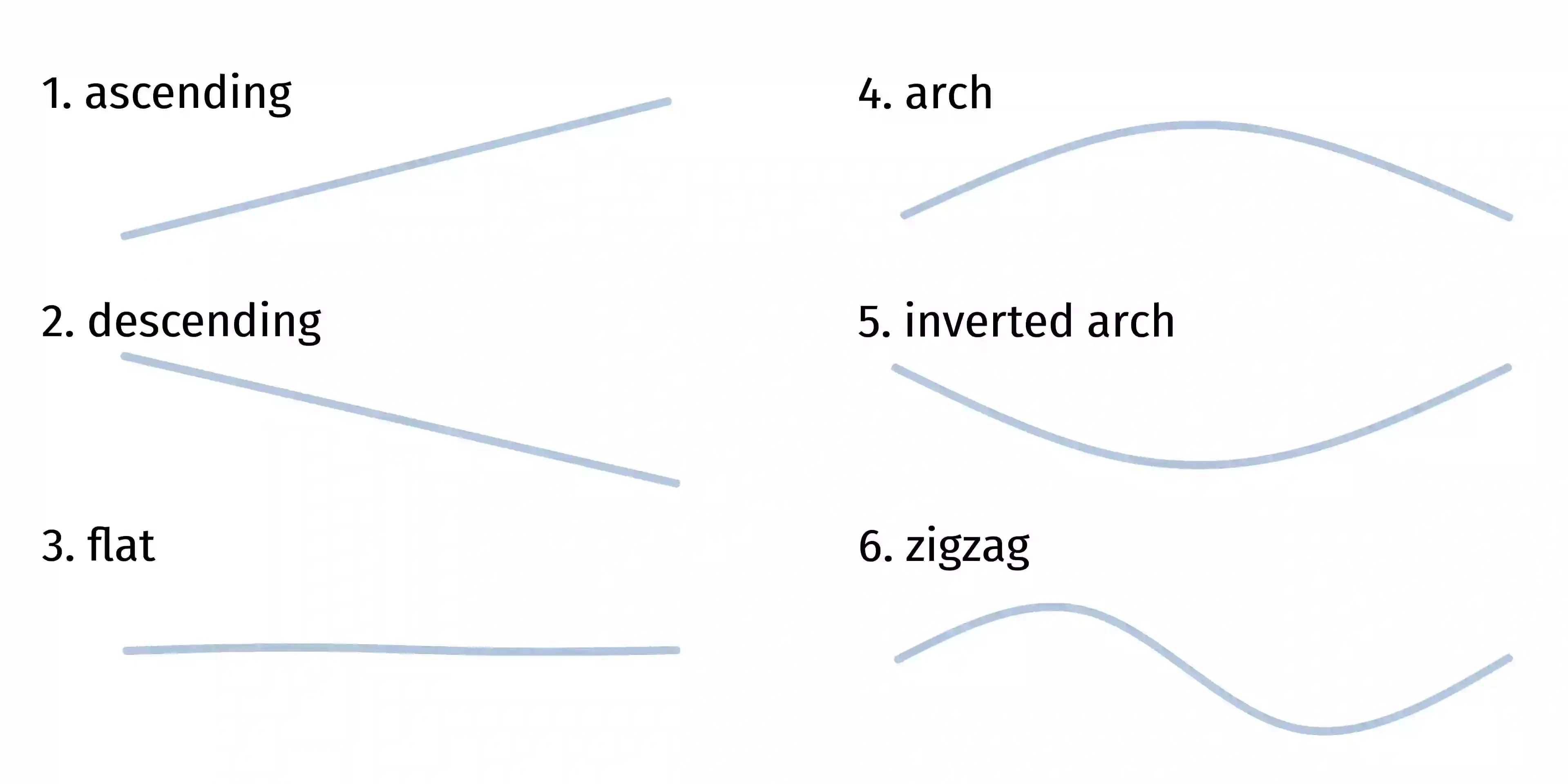
"Jarabe Tapatío" seems like a perfect example to demonstrate the concept. At a glance, we can easily recognize its overall contour as an inverted arch built from two straight lines.
"Jarabe Tapatío" (Mexican Hat Dance), by Jesús González Rubio
Listening closer, we notice two different sorts of "straight" lines. If the descending line has a serrated edge, the ascent is straight as a razor.
"Jarabe Tapatío" with melodic figures marked
This distinction gets to the heart of how MFT understands melodic shape: as a dynamic process shaped by motion at all three levels—macro, mezzo, and micro. The "inverted arch" analysis captures only the macro layer with plenty of fancy footwork happening below.
1. Macro motion (phrase and section): the dramatic arcs that structure a melody's large-scale shape.
2. Mezzo motion (figure and gesture): the pattern-rich level where melodies develop their personality and drive.
3. Micro motion (note-to-note): the fine details—like the chromatic inflections in the first two Auxiliary figures (above) that tighten up the note-to-note motion.
Something drastic happens when we build both halves of the tune from the same figures. Although we preserve the macro contour, the melody loses its zing.
Alternate versions of "Jarabe Tapatío"
A. Shape as a means to continuity, variety, and contrast.
The most fundamental—and straightforward—use of shape is also its most versatile: shaping gestures to continue, vary, or contrast with one another. Even stark contrast qualifies as straightforward behavior here. A composer who follows an ascending gesture with a descending one isn't doing anything unusual—they're working within melody's most natural logic.
Composers across all eras have used shape as a way to contrast one melodic gesture with another. In fact, when it comes to building contrast, we even find identical pairings, as the Arpeggio + Double 3rd combinations below.
"Allegro molto," from Symphony #40, by Wolfgang Amadeus Mozart
"Sidewalks," by The Weekend
Of course, shape can also provide a means of continuing (i.e., repeating) gestures. The two similar figures in this song are frequently heard together.
"Itsy Bitsy Teenie Weenie Yellow Polka Dot Bikini," by Brian Hyland
B. Melodic tailoring.
"Itsy Bitsy Teenie Weenie" is a prime example of "melodic tailoring," a key compositional technique MFT can offer helpful instructions for. There are two kinds of melodic tailoring.
1. Adaptive tailoring. Say your friend suffers from anisomelia (a condition in which two paired limbs differ in length), and so he routinely takes new trousers to the tailor. A professional-looking alteration is one where no one notices. Composers can face a similar situation when repeating melodic ideas, as we hear in "Itsy Bitsy Teenie Weenie." The composer adjusts intervals, hoping the alterations will blend in seamlessly.
Naturally, when we adjust intervals, we often end up changing melodic figures. Yet there are always several figures that share the same shape. Once again, the table of melodic building blocks provides a handy resource. For example, here are three shape types with three figures that meet their criteria.
Some similar shapes found among melodic figures

2. Face-saving tailoring. Often, it's possible to repeat/continue a melodic idea exactly or nearly so, but the results sound too formulaic (sometimes even goofy). Imagine if our national anthem went like this:
"The Star-Spangled Banner," by Frances Scott Key
3. Expressive tailoring. Often enough, a composer will choose to repeat a melodic gesture more emphatically the second time around. We call this "expressive tailoring." In expressive tailoring, we preserve the contour but make it "bigger." In melody, this either means translating steps into leaps, or making small leaps larger. (Using the previous analogy, imagine your friend got his trousers back only to find that the tailor made them into bell bottoms!)
Altering the registral span to achieve expressive tailoring.
Fogerty's melody for "Oh, boy!" shows that expressive tailoring doesn't need to be drastic to make a dramatic impact.
C. Nested figures.
Beyond repetition or contrast, MFT reveals a deeper kind of correspondence—one that's often felt but rarely noticed. It's a phenomenon I call nested figures: 3-note figures that recur beneath the surface of 4-note figures, creating subtle familiarity—a sort of musical déjà vu—something familiar nestled inside of something new.
Every 3-note figure serves as a "torso" for several 4-note figures. Here are a few examples.
Some examples of nested figures.
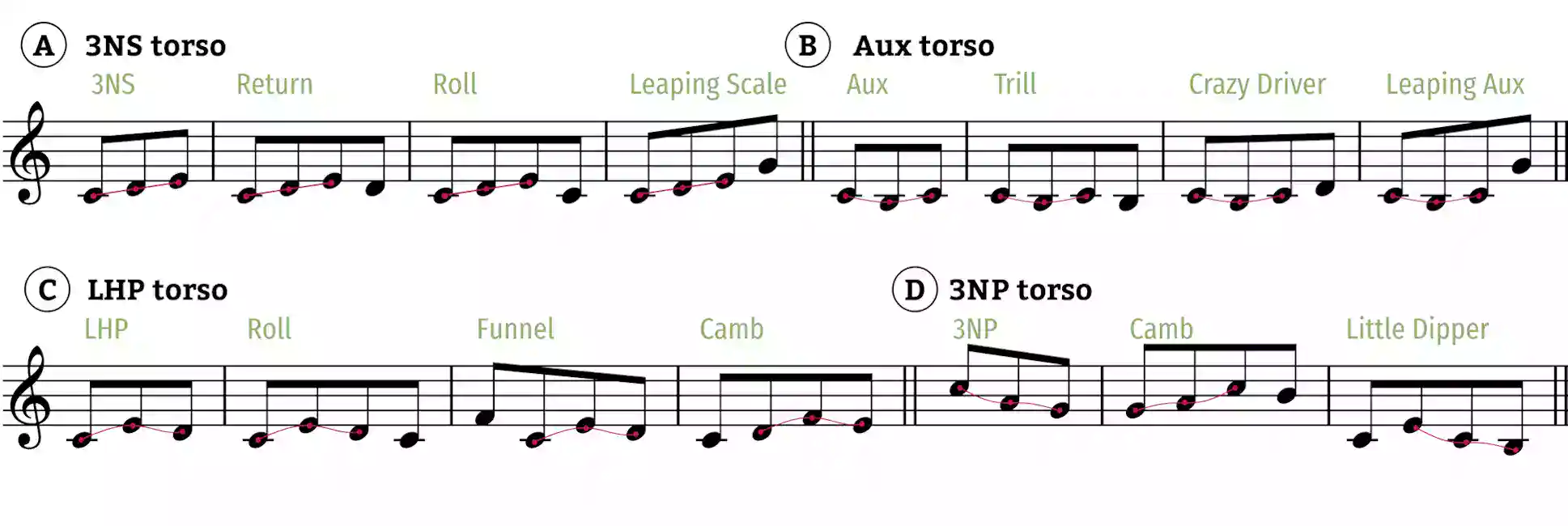
For a real life example, the opening gesture of "Always on My Mind" (on "Maybe I") is sung to a consonant 3-Note Scale. The "I" hangs alone, vulnerably so. The response (on "quite as often") is sung to a Return figure, which, because it contains a 3-Note Scale, makes it feel like a repetition of the first gesture. But not so fast.
"Maybe I" (3 syllables) and "quite as often" (4 syllables), though unequal in length, are corresponding gestures. Still, both could have used just 3 pitches (as shown in the ossia). The "extra" note (E4) at the end of "often" chafes uneasily against the B minor harmony, highlighting the departure from what should have happened. That friction captures a sense of regret—musically expressing what the lyrics only hint at. We do and don't hear straightforward continuity as the confession unfolds. And there's the rub.
"Always on My Mind," by Wayne Thompson, Mark James, and Johnny Christopher
This next country song is also tangled up in mixed feelings about love. Its matter-of-fact opening gesture captures Eddie Dean's boredom with his wife. In contrast, the second gesture—where Dean sings about his mistress—unfolds with a more compelling contour and opens up a wider registral space. And yet the contrast isn't as stark as it first seems. The second gesture grows organically from the first, thanks to a shared nested figure—an LHP, circled in red.
The second phrase (bars 5–8) sort of transposes the first phrase (bars 1–4) up a step. Let's listen for its notable alterations.
First, in straightforward transpositions, the melody and harmony rise or fall together. But here, only the melody in bars 5–8 moves up a step. Despite my marking G4 in bar 5 as the 9th, the Roll (on "one I'll remain") the relationship between figure and harmony is far better understood as a case of harmonic divergence. Given the singer's story, it's hard not to hear the disconnect between melody and harmony as a tell.
Second, Dean's melodic transposition breaks at "heartaches," the emotional centerpiece of the verse. Like the first three gestures, this one also contains a nested LHP figure, but it's chromatically inflected, adding a sharply-felt constriction at "heartache."
"One Has My Name the Other Has My Heart," by Eddie Dean
Among composers and musical experts, "melodic development" has long been the gold standard of compositional mastery. Melody can be "developed" in many ways—through variation, reharmonization, phrase extension, fragmentation, sequence, to list a few. MFT adds a new method to the list: nested figures. But nesting operates at a different level than the techniques above. It's what happens when a composer's ear is working at its most refined—when technique disappears and resonant listening takes over.
Composers have always heard these deep connections intuitively, long before anyone had a name for them. MFT gives them a name—which means what was once felt can now be found, studied, and deliberately pursued. Covert, fully organic, brimming with expressive consequence—in both "Always on My Mind" and "One Has My Name," nested figures intensify the singers' inner conflicts by having the story and melody develop in tandem.
Wrapping up. The shape templates we hand students ignore its smaller details—much like a state map that flattens a scenic country road into featureless lines and curves. Follow that map and you'll get where you're going, but you'll miss everything worth seeing (or end up driving through some poor farmer's field). Melodic Figuration Theory treats shape as a multi-layered topography instead, with macro, mezzo, and micro motions working both together and independently—each level capable of straightforward or modified behavior, sometimes simultaneously. Tailoring gives composers precise control over how melodic ideas repeat and evolve. And nested figures take that control to a level where technique disappears, resonant listening takes over, and the melody seems to follow its own enigmatic yet inevitable logic.
Where's Rhythm?
By now you may be wondering where rhythm fits in. Tier 2 maps five dimensions of figural behavior—and rhythm isn't one of them. Why?
Each of the five dimensions passes a clear test: a straightforward behavior the figure tends toward, and a modified behavior the composer can produce by overriding it. Rhythm doesn't pass that test. The ways to rhythmicize a figure are endless, and no rhythmic choice can be called straightforward or modified in any principled way. A 3-Note Scale is a 3-Note Scale whether it's three even quarter notes, a dotted half plus two sixteenths, or a syncopated triplet. The figure's identity survives any rhythmic treatment.
That doesn't mean rhythm has no place in MFT. We just don't consider it a dimension of figural behavior. Tier 3 picks up rhythm at the figure-to-gesture transformation; and Tier 4 returns to it in the form of rhythmic schemas.
There's a deeper point here. A melodic figure with no rhythm isn't yet music. Add rhythm and the figure becomes a melodic gesture—the smallest intact unit of melody. Rhythm isn't a dimension of the figure. Rhythm is what brings the figure to life.
TIER #3: MELODIC SYNTAX
Just as speakers and writers form sentences by arranging words into clauses, and clauses into phrases, composers and performers form melodies by arranging figures into gestures, and gestures into phrases. This section takes a close look at this process with a focus on making and responding to melodic gestures.
[1] From Motion to Meaning: The Expressive Power of the Melodic Gesture
No doubt you've noticed that I've been using the word gesture rather than the more common terms like fragment, segment, cell, or motive. Why? Because the standard, clinical terms reduce the smaller parts of a melody to materialist abstraction.
In contrast, a gesture is a kinetic force. A gesture harnesses conviction and emotion to convey meaning with immediacy. We wave our hands to say "Stop!" "Slow down!" or "Come closer!" We put a finger to our lips to ask for silence. Yet the majority of the gestures we make throughout each day don't carry specific messages: instead, they capture and convey the conviction and feeling beneath our words. Likewise, as the notes in a melody move, they trace out sonic shapes that embody the same emotional energy as the gestures we make with our hands and bodies when we talk.
A. From figure to gesture: how motion becomes expression.
A figure, on its own, isn't yet a melody. Its kinetic potential is real—but that potential needs a trigger. Rhythm is that trigger. The moment a composer rhythmicizes a figure, potential becomes motion, and motion becomes expression. That's when the gesture is born. In this way, the gesture—not the figure—is the smallest intact unit of melody.
A melodic gesture can be conceived in either of three ways. Sometimes we start with a melodic figure and rhythmicize it—stretching one note, repeating another, shifting accents to create momentum or hesitation. Other times, we begin with rhythm (for example, the rhythm of lyrics) and "figure-ize" it, finding just the right shape to make the words really sing. And yet other times, often actually, both emerge at once—spontaneous and inseparable—the way they do in improvisation.
B. Each melodic figure can produce an unlimited number of melodic gestures.
As a case study, I'll show several melodies that begin with the same figure: a Leaping Auxiliary. But first, I'll show why this particular figure is so flexible. (Not all figures are!) Each Leaping Auxiliary has two defining components:
1. A chordal leap, which can be any size and move up or down.
2. A three-note auxiliary configuration, where the neighbor tone can move in either direction.
What's more, either the leap or the auxiliary configuration can come first—doubling the number of possible ways this figure can unfold.
All possible arrangements of a Leaping Auxiliary based around C4, E4, and G4
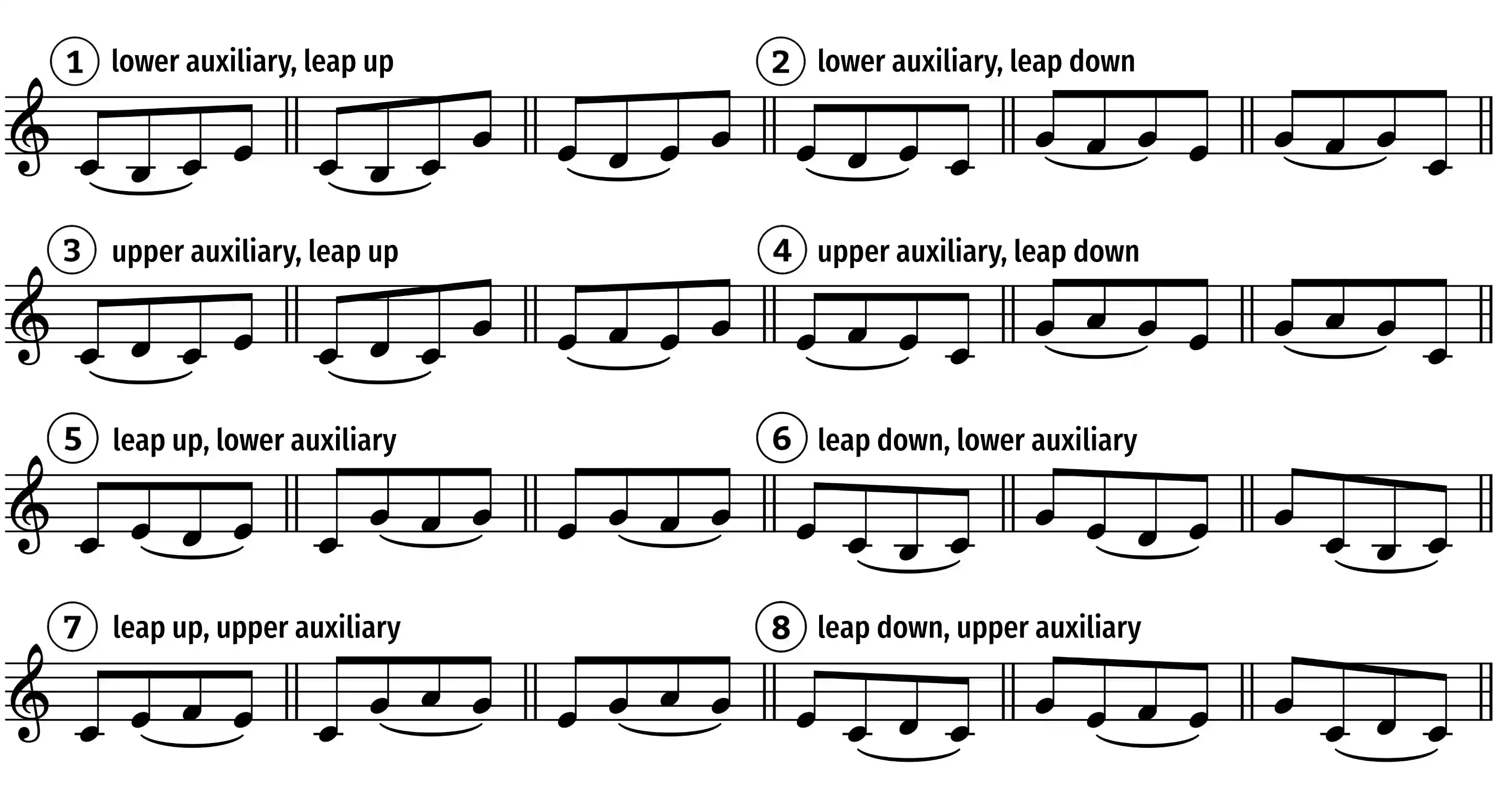
And once rhythm enters the equation, the number of possible gestures explodes into infinity. Here are but a few.
Some melodies that begin with a Leaping Auxiliary figure
[2] Not Just One Thing After Another: The Responsive Logic of Melody
Whenever you or I compose a melody, we intuitively do two things that feel so natural we barely notice them.
In other words, each melody unfolds like a conversation. Something gets "said." Then something else gets "said" in response.
And here's the heart of it: there are only three ways to respond to any gesture (or phrase, or section). We can (1) repeat it, (2) vary it, or (3) contrast it. These are the same options we have when talking. One person says something; the other agrees, adds a twist, or says something contrary or new.
In this example, I apply all three options to respond to the first gesture in "Twinkle, Twinkle."
Now, within these three basic responses lies a vast range of possible behaviors—25 distinct ways to repeat a melodic gesture, 25 ways to vary it, and 25 ways to contrast it: 75 options in all. Each response creates a different effect—and each can be learned.
In the subsections that follow, I offer a few representative examples of each type of response. As I do, I'll spotlight aspects of MFT that come into play.
A. Three ways to repeat a gesture.
Picture a typical day in your studio. You stumble upon an opening gesture you like, but you're not crazy about any of the follow-up responses that first come to mind. So you look through MFT's catalogue of 25 continuation responses and choose a few to try.
Repetition #1: Respond with a chordal arpeggiation sequence.
[drawing upon: harmony melody, shape, and adaptive tailoring]
A "chordal arpeggiation" sequence keeps the same harmony while repeating its gesture starting on a different chord tone each time. As a result, the size of some intervals will change from gesture to gesture, just as they do when we invert chords. (E.g., in figured bass: 5‑3, 6‑3, and 6‑4).
Repetition #2: Respond with an "adaptable sequence."
[drawing upon: harmony melody, shape, adaptive tailoring, and expressive tailoring]
An "adaptable sequence" has much in common with an arpeggiated sequence. Both repeat their segments while allowing for intervallic adjustments whenever the melodic segments and harmonic progression don't move in tandem, as they do in a standard sequence (e.g., a circle of 5ths sequence).
For example, look at the first beat of the first two segments of the sequence below. The melody proceeds down a step (from C4 to B3), but the harmony drops a 4th (from C major to G major). That means we can't simply transpose directly but need to tailor the second iteration so the Leaping Auxiliary fits the chord tones to most closely resemble the original. It's the kind of thing that happens all the time—yet I've never seen it named, let alone taught.
You'll also notice that I used a different sort of repetition for the last iteration. Rather than continue with "adaptive tailoring" I switched to "expressive tailoring" for the last iteration—a very common strategy in this situation. While we're here, this example helps us better understand the difference in intent between adaptive and expressive tailoring. The former seeks to repeat without the listener noticing any changes (as in bars 1-6); the latter intentionally varies the repetition for expressive purposes (as in bars 7‑8).
Repetition #3: Respond by repeating part of the gesture.
[drawing upon: nested figures]
Here, repeating just the second half of the first gesture creates a new figure: the Trill.
Pretty good, but it doesn't pique your imagination. So you try repeating bar 2 two more times (as you just did), but this time, using different notes for each repetition. You notice that it's possible to create a Run while repetiting the 2-note gesture.
Repetition #3 (alternate): Respond by repeating the ending on different notes.
B. Two ways to vary a gesture.
Variation #1: Respond by adding figuration.
[drawing upon: direct and indirect connections and the Vocabulary of Melody table]
The highlighted notes show that both the proposition and the response use the same melodic outline. By using the Vocabulary of Melody table we can approach any target note taking a direct or indirect path.
Variation #2: Respond by varying the metric placement.
[drawing upon: metric placement]
In this example, I've chosen to vary the length of the initial gesture.
Variation #3: Respond by varying the gesture length.
[drawing upon: the MFT formula for making gestures]
C. Two ways to contrast a gesture.
Musicians are often surprised to hear that contrasting a gesture effectively is harder than it sounds. I draw this conclusion from my own work as well as working with students for over 30 years. So the final stop on this brief tour of melodic syntax will demonstrate the power of the "5 Dimensions of Figural Behavior" to help a composer find something different to do.
Contrast #1: Contrast simplicity with complexity.
[drawing upon: melodic shape]
Contrast #2: Contrast the registral span.
[drawing upon: melodic register and melodic span]
Here, the response not only inhabits a smaller registral space than the proposition, it's also in a higher tessitura.
TIER #4: MELODIC SCHEMAS
In Tier 1, we met the vocabulary of melody—not as a catalog of inert patterns, but as a roster of active agents. These figures give us the ability to make precise behavioral comparisons between one musical situation and another.
Armed with this vocabulary, Tier 2 broadened our view to the inner workings of melodic motion, mapping how melodic figures negotiate the forces of harmony, meter, register, and shape—each with both a straightforward way of moving and a modified way of surprising us.
Tier 3 showed how each melody unfolds like a conversation—a conversation between melodic gestures. Something gets "said" (the composer puts forth a melodic gesture) then something else gets "said" in response (the composer repeats it, varies it, or contrasts it).
This brings us into the world of musical schemas, which we explore in this section.
An overview of musical schemas.
The past few decades have brought a quiet revolution in music theory. Researchers led by Robert Gjerdingen and others have built out the systematic study of schemas—recurring patterns or frameworks that composers, improvisers, and performers recognize instinctively and then draw on to create or interpret music. The first wave of this work mapped the schemas of 18th-century European music in remarkable detail; a newer wave is extending schema thinking to jazz, popular music, and beyond. These schemas act as a kind of auditory scaffolding, capturing the essential structure, function, and feel of common musical situations. Some key characteristics include:
- Recognizable Patterns. A substantial part of becoming a musician involves drilling core formations—the cadential 6/4, the ii–V–I jazz, or the architecture of a sonata—until the patterns learned by rote eventually become second-nature hearing.
- Cognitive Efficiency. Schemas accelerate real-time decisions. An improviser doesn't think "measure 1, chord I; measure 5, chord IV"—they sense the twelve-bar blues structure and let it guide their fingers.
- Flexible Application. Schemas invite creative manipulation rather than mere imitation. A composer writing a new concerto or string quartet isn't simply following a recipe—they're working within a living framework, pushing against its expectations, subverting or fulfilling them for expressive effect.
- Cross-Genre Validity. Many schemas transcend individual styles. The circle-of-fifths progression underpins everything from Baroque chorales to jazz standards to contemporary pop. The lament bass migrates from Renaissance madrigals to Baroque arias to rock ballads. The more you look, the more you find the same deep structures surfacing across centuries and genres.
What gives schemas their analytical and creative power is something subtler than recognition alone. Schemas survive elaboration. A cadential 6/4 remains a cadential 6/4 whether it appears austerely in a chorale or gets dressed in florid passagework. That durability is what makes shared schemas useful—trained ears can compare one situation to another in common terms, even when the surfaces look nothing alike. This is precisely the contribution melodic figures bring. Just as schema research revealed that bass lines, voice-leading frames, and scale-degree patterns remain recognizable through elaboration, MFT reveals that melodic figures do the same in a variety of contexts.
This section explores five ways MFT extends the work of established schema research.
[1] WAYS TO INTEGRATE MELODIC FIGURES WITH STANDARD MUSICAL SCHEMAS
Melodic figures pair instinctively with familiar musical schemas—whether in their basic form or through one of their modified applications. For instance, take the cadential 6/4 formula, whose melody is often built around a 3-Note Scale. By applying the principle of nested figures, we get new elaborations.
Using nested figures to elaborate a common 6/4 melodic formula
[2] SCHEMAS FOR USING EACH MELODIC FIGURE
Each of the 24 melodic figures brings its own signature straightforward and modified behaviors—abilities it excels at plus common ways to stretch or alter those behaviors. Take the Crazy Driver for example.
This traffic graphic illustrates two reasons for the Crazy Driver's mnemonic name. Both represent its most common behaviors, yet as you'll soon see, there's another that's even crazier. These two options here are straightforward because they move as directly to their targets as possible. That said, moving to a goal a 3rd away is even straightforward-er than swerving around the same note.
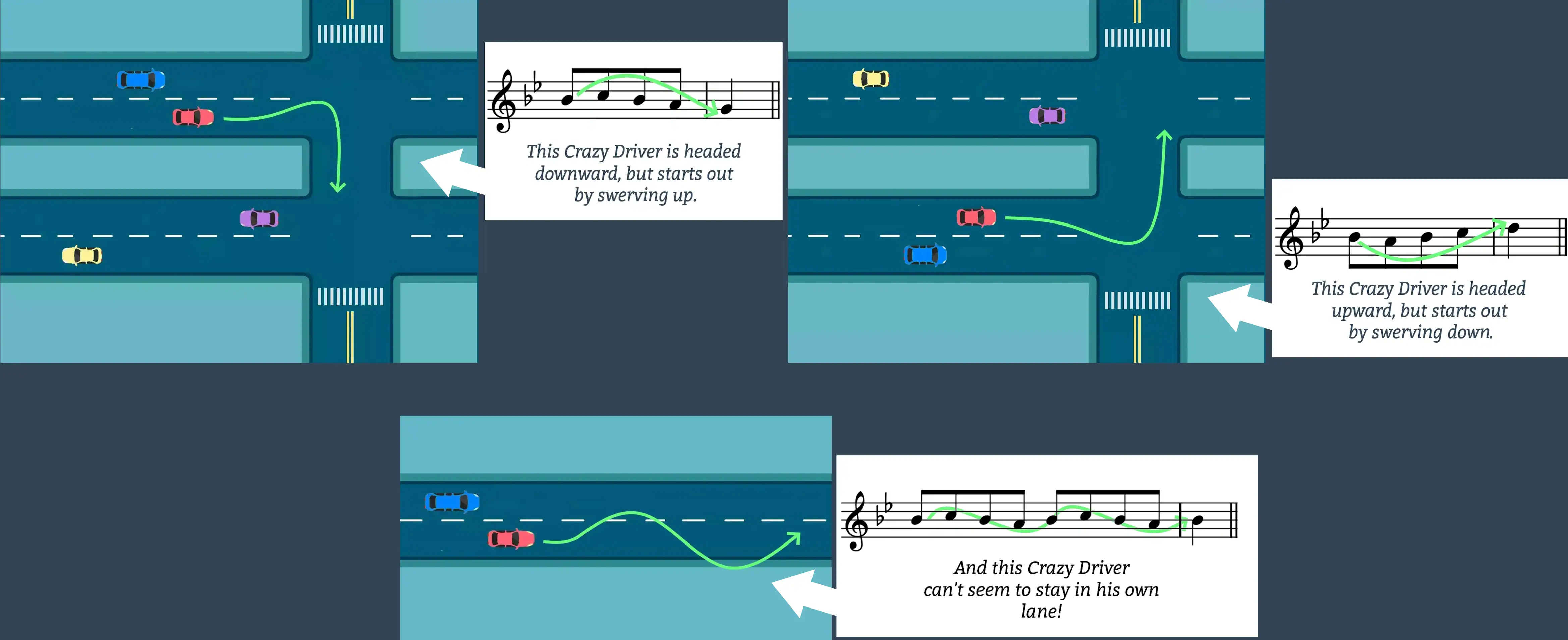
Now, in actual contexts. First, the Crazy Driver traveling to a target a 3rd away.
"Joshua Fit the Battle of Jericho," Negro Spiritual
Next, the Crazy Driver returning to the original pitch.
"Toreador Song" from Carmen, by Georges Bizet
This final Crazy Driver schema creates an accented link (covered in the Connection section). Each of the three songs below accent an important note through a modified treatment of the Crazy Driver figure.
[3] USING THE FIVE DIMENSIONS OF FIGURAL BEHAVIOR TO GENERATE SCHEMAS FOR GESTURES
We've explored the five dimensions of figural behavior across Tier 2. Tier 4 extends those same dimensions to the gesture level, producing flexible schemas composers can carry from one musical situation to the next. In this section, we'll focus on the metric dimension — and on rhythm, which (as promised at the end of Tier 2) joins the picture once figures become gestures. The three schemas ahead each combine metric placement with rhythmic patterning to generate gesture-level templates.
A. The "6 Shorts and a Long" Schema
One of the simplest categories of rhythmic schemas combines short and long notes in a specific count and order. One requirement of this type of schema is that it repeats at least once. For example, take the "giddy-up" rhythm at the beginning of the "William Tell Overture" (2 Shorts and a Long), or Beethoven's "fate motif" (3 Shorts and a Long). Each one underwrites hundreds of melodies—which is what earns it the status of schema. Yet as with pieces that share identical melodic figures, the same basic rhythmic material can produce quite different results.
The schema we'll consider here consists of "6 Shorts and a Long" (6S+L). Before I offer any observations, listen to a few instances.
Examples of the "6S+L" schema
The most compelling feature of the 6S+L schema is the way the long final note acts as a rhythmic goal. Depending on the figures involved, the short notes sometimes feel drawn toward the goal; other times they don't. Every melodic gesture has a shape, of course. But in rhythmic patterns like the 6S+L that set up an agogic accent, a shape is not simply a shape, but a shape with a mission statement. Listen for whether each contour pushes toward the final long note or takes a more scenic route.
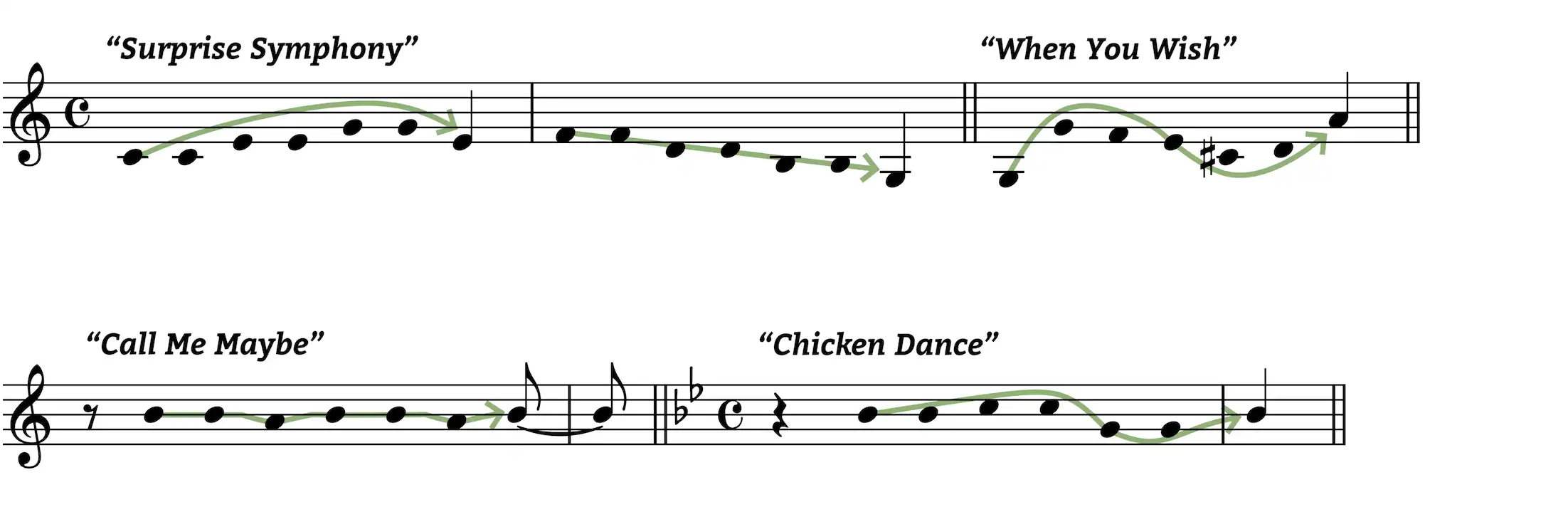
Metric placement further enriches the interplay of melodic shape and rhythmic goal.
Starting the 6S+L on a strong beat results in an upbeat agogic accent (as in the first two excerpts); while starting on an upbeat creates a ligature effect—with the agogic accent on an upcoming strong beat (as in the remaining three).
Starting the 6S+L on a weak beat puts the final long note on a strong beat, creating a ligature effect. The song "Big Shot" further complicates the schema. The start and end of the 7-syllable lyric line are out of phase with the start and end of the 7-note 6S+L. One final thought on this song. Wouldn't it be rich if the big shot Eilish wrote about discovered that the chorus mocking his toughness is just a slightly reworked version of the Chicken Dance?
B. The Perforated Melody Schema
Both of these songs by Stevie Wonder use fragmentation. Yet they're different. How?
The difference is easier to hear in the lyrics than in the music. Listen to what each song's fragments do as language.
⯈"Very superstitious." Complete adjective phrase. Stands on its own.
⯈"Writings on the wall." Complete noun phrase. Stands on its own.
Each fragment finishes a thought. The pauses fall between thoughts.
Now the other song:
⯈"I just called" hangs. Called to do what?
⯈"to say" hangs even harder. To say what?
Neither fragment finishes anything. In fact, each one opens a slot the next fragment has to fill. The pauses fall inside a single thought that hasn't finished projecting itself.
The music behaves the same way. In "Superstition," each musical fragment feels complete — a bounded utterance the ear accepts as self-sufficient. The pauses register as breaths between full statements. In "I Just Called," each musical fragment feels unfinished. Two notes are rarely enough to register as a gesture on their own; the ear listens past them for what comes next. So the fragment hangs, and the listener waits.
What "I Just Called" demonstrates is a specific compositional pattern worth naming: the perforation schema. Its formula: 2-note iterations (occasionally 3), in a quick upbeat-to-downbeat rhythm, distributed across pauses.
That combination of brevity and metric tilt is what separates the schema from generalized perforation. General perforation puts pauses between gestures—each gesture is complete, each pause a breath. The Perforated Melody Schema uses fragments are too brief to stand on their own and so, have nowhere to go but into the next iteration.
The cognitive arc the schema produces unfolds in stages. The first iteration is maximally ambiguous—two notes, no precedent, nothing to compare against. The listener holds them in suspension. The second iteration is where pattern recognition kicks in, retrospectively. The shape, brevity, and metric position of what just arrived reveal that the first fragment was the opening of a series. The ear now knows what to listen for. By the third iteration, expectation is fully primed. The schema is locked in, and any deviation reads as expressive variation.
So the schema's effect isn't constant. It intensifies as the schema unfolds. The listener moves from suspension to recognition to anticipation, and the composer can play any of those states for different effects—extending the suspension, confirming the pattern early, withholding the expected continuation.
Lyrics aren't mandatory to create perforated melody. The same suspension, the same retrospective recognition, the same anticipatory pull—all available in instrumental melody.
Both language and melody run on a brain that doesn't wait for complete information. It races ahead, filling gaps, anticipating patterns from partial cues. Perforated Melody is what happens when a composer trusts that machinery and writes for it directly, giving the listener tantalizingly incomplete fragments and letting their pattern-completion do the rest.
C. The "Anda-2" schema
Most melodies tend to launch surefootedly—squarely on beat 1 of bar 1. "My Funny Valentine" doesn't. It uses what I call the Anda-2 schema, shifting the center of gravity headlong onto the next strong beat—beat 2 in hypermeter (notated in the analysis). The melody leans into a downbeat that hasn't arrived yet.
"My Funny Valentine," by Richard Rogers
What does the ear experience when a melody enters on beat 2 of hypermeter rather than beat 1? Something close to mid-stride entry. The meter is already in motion before the melody arrives, as if the song has been going on without us and we've only just tuned in. The first downbeat passes without a melodic event to mark it — yet the meter is fully present. The performer has had to internalize that silent downbeat to set the metric cycle in motion and ride it ("Anda") into the upcoming "2." That displacement is what gives "My Funny Valentine" its particular emotional posture: vulnerable, already in feeling, mid-thought rather than declarative. The schema sits at exactly the intersection two recent theorists have mapped: Christopher Hasty on meter as something the listener projects forward, John Paul Ito on meter as something the performer's body enacts. The Anda-2's silent downbeat is the moment where both perspectives converge.
Now imagine that the composer of "Twinkle, Twinkle Little Star" loved her figure combinations but wasn't wild about their overall flow. So, she reconfigures it to fit the Anda-2 metric schema.
"Twinkle, Twinkle," adapted to the Anda-2 metric schema
And while the composer was at it, she worked in the expressive outburst from "My Funny Valentine." Both modifications strike at the schema's most vulnerable spot—right at the arrival point, where the Anda lands on the "2. Breaking the stepwise motion just before the downbeat creates the expressive accent—the same formula introduced in Tier 2 under Connections.
What you've heard here is but three applications of a method for generating schemas: extending one of the dimensions of figural behavior—in this case meter—to act upon melodic gestures. The same method applies to the other four dimensions—harmony, register, connection, and shape—each generating its own family of gesture-level schemas.
[4] USING MFT INSIGHTS TO BUILD PHRASE SCHEMAS
Given that every element of music follows a familiar pattern, framework, or mental template, isn't it odd that we have just two schemas for building complete phrases: the musical period and the musical sentence? Yet countless phrases don't fit neatly into either category. In fact, many share traits that could justify adding new phrase types to our toolkit someday.
What I want to explore here is how to use MFT's tools to build "one-off phrase schemas": imprinting the behaviors of one phrase onto new melodic materials. To demonstrate, I'll derive an MFT phrase schema from a Beatles tune I just caught on the dad-rock station while driving home from grocery shopping. "Lady Madonna" is a musical sentence, but not "just" a sentence (if there's any such thing?). By analyzing the specific sorts of syntactical behaviors MFT emphasizes, several distinctive traits emerge.
"Lady Madonna," by Lennon & McCartney
Now I'll use these distinctive traits as a schema, reworking the melodic figures of "Twinkle, Twinkle."
Wouldn't you know it? I hit one snag right off the bat. "Twinkle" starts with a perfect fifth, already too wide to qualify as a small‐span gesture (which describes the first gesture of "Lady Madonna"). Yet that opening perfect fifth is part of a Leaping Auxiliary, which contains a nested Auxiliary figure which offers several options.
I wrote three options (A–C) using "Lady Madonna's" rhythm. (Even though preserving the rhythm is not a necessary part of adapting a schema to new figures, it can yield some cool results.) Yet since I've chosen the minor mode, this rhythm feels a bit too energetic to me today. So I decided to simplify it, hence versions D–F. Still nothing I like. So I tried related figures, and found the Double Neighbor has two nested auxiliary figures, which, after some chromatic alchemy (H), I love.
"Twinkle, Twinkle," adapted to Lady Madona's phrase schema
[5] SCHEMAS FOR BREAKING SCHEMAS
Many composers tend to be leery of schemas. Relying on models, templates, and formulas can feel like a crutch. The attitude takes root early: when a teacher shows "the right way" to do something, it's usually with a tacit understanding — first you learn the rules, then you break them.
But do we really break the rules at random? With no intended effect? No regard for context?
The point is: there are schemas for breaking schemas.
Composers across periods, styles, and genres have taken the same detours to achieve the same effects. They've inadvertently invented the same modifications — the same schemas for breaking norms. Not recklessly, but with expressive intention. And because MFT lays out how the most straightforward figures and gestures behave, it has a clear vantage point on how, why, and when to modify them.
A. Make the neighbor note and chord tones reverse places.
It's possible to write two different Auxiliary Figures using the same two notes. Doing so produces an inside-out Auxiliary Figure with the non-chord tones on the outside and the skeletone in the middle.

In "Won't You Be My Neighbor," the oscillation feels like winding the propeller on a toy airplane—each turn twisting the rubber band tighter—then releasing it right on cue to land hard on the first syllable of "neighbor."
"Won't You Be My Neighbor," by Fred Rogers
The next two songs arrange pairs of Auxiliary figures to create a slower-moving scale in the background that drives each phrase. In "My Favorite Things," the quarter notes and pauses trade pent-up energy for anticipation—each pair winds, waits, then resolves into the next.
"My Favorite Things," by Rogers & Hammerstein
Bizet sets up a pattern of regular pauses between the initial Auxiliary Figure and its inside out version. The result is that we hear the figure turn itself out more clearly than when there's no pause. Also, the inside out versions create magnetic pickups to the upcoming Auxiliary Figures.
"Toreador Song," by Georges Bizet
B. Turn the middle note of an Auxiliary figure into an appoggiatura.
By using a straddled metric placement for the Auxiliary Figure, we create a situation where notes 2 and 3—a step apart—need to find their proper roles within a single harmony. The most obvious choice? An appoggiatura moving to a chord tone.
"Barber of Seville," by Gioachino Rossini
The straddled Auxiliary Figures in "Happy Birthday" set up a dominant restatement schema. Typically, after two iterations, new melodic material takes over. But not here. Happy Birthday fakes a third iteration—then explodes. Anyone who's wondered why this song has enjoyed such popularity hasn't recognized the genius of this prank.
"Happy Birthday," by Mildred and Patty Hill
Oddly, Brahms uses a nearly identical phrase schema as "Happy Birthday" in this intermezzo. But although the surprise uses the same engineering, the rich harmony complete with pedal tone makes this unexpected ascent poignant rather than goofy.
"Intermezzo," by Brahms, Op 118 No 2
At the first interruption, the line leaps a 4th from A4 to D5—mild, as leaps go. The second time, that leap blossoms into a glorious 6th. The first phrase sets up the second. David Temperley named this one-two punch the expanding ascending interval. MFT treats it as a particular case of expressive tailoring—where an ascending leap grows across repetitions.
BRINGING MELODIC LOGIC INTO PLAIN VIEW
We started with two melodies that share the same notes in the same order—"Twinkle, Twinkle, Little Star" and "What a Wonderful World"—and asked why they feel like twins with nothing in common but their notes. Now we have an answer.
⯈"Twinkle, Twinkle" follows the rhythmic schema: 6 Shorts and a Long. "Wonderful World" runs two rhythmic schemas at once: Perforated Melody and Anda-2.
⯈In "Twinkle, Twinkle," the second phrase responds to the first through direct contrast (Tier 3). In "Wonderful World," a single opening gesture spawns a chain of shorter responses. The two different responses produce two different phrase shapes.
⯈"Twinkle, Twinkle" traces a compact arch. "Wonderful World," through its perforation, pulls six of its eight tones into a single stretched-out scale. Same figures—the Leaping Auxiliary and the Run—but very different shapes.
That's why these two melodies feel so different despite sharing the same notes in the same order. The notes are identical; the behavioral forces shaping them are not.
Most of us learned to explain melody on two levels: note-to-note motion at the micro level and harmonic underpinning at the macro level. Both still matter. Absolutely. But between them lives a third, long-overlooked mezzo level: a teeming, kinetic system with its own agents, its own logic, and its own motives for behaving the ways it does.